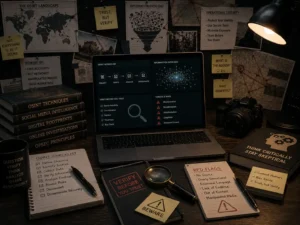
Embarking on a Career as an Intelligence Analyst
Welcome to our comprehensive guide on OSINT (Open Source Intelligence) for law enforcement agencies. In today’s digital age, information plays a crucial role in solving crimes and ensuring public safety. OSINT refers to the collection, analysis, and utilisation of publicly available information from open sources.
In this article, we will delve into the world of OSINT and explore how it empowers law enforcement agencies to gather intelligence, uncover hidden connections, and enhance investigations.
So, let’s begin our journey into the realm of OSINT for law enforcement.

OSINT for Law Enforcement: Understanding the Basics
What is OSINT?
OSINT, short for Open Source Intelligence, is the process of gathering and analysing information from publicly accessible sources. These sources can include social media platforms, online forums, news websites, government databases, and more. By leveraging OSINT techniques, law enforcement agencies can gain valuable insights, identify patterns, and generate leads to support their investigations.
Why is OSINT Important for Law Enforcement?
OSINT has become increasingly crucial for law enforcement agencies due to the proliferation of digital information. Criminals often leave digital footprints that can be uncovered through OSINT methodologies. By harnessing the power of OSINT, law enforcement agencies can:
- Gather Actionable Intelligence: OSINT enables law enforcement officers to collect information that can be used as evidence in criminal cases or to identify potential threats.
- Detect and Prevent Crimes: By monitoring online activities and identifying early warning signs, law enforcement agencies can proactively prevent crimes and protect communities.
- Uncover Hidden Connections: OSINT allows investigators to establish connections between individuals, organisations, and events, unraveling complex webs of criminal activities.
Enhance Criminal Investigations: By leveraging OSINT tools and techniques, law enforcement agencies can supplement traditional investigative methods and expedite their efforts.
The Process of OSINT for Law Enforcement
Step 1: Planning and Objective Setting
Before diving into OSINT operations, law enforcement agencies must establish clear objectives and define the scope of their investigation. This step involves identifying the information needed, potential data sources, and the tools and techniques required to gather and analyse the information effectively.
Step 2: Data Collection
In this stage, law enforcement officers collect data from various open sources. It can involve monitoring social media platforms, scanning news articles, accessing public records, and exploring online communities relevant to the investigation. OSINT tools and search engines play a crucial role in efficient data collection, allowing investigators to narrow down their search and uncover valuable information.
<h3″>Step 3: Data Analysis
Once the data is collected, it needs to be analysed to extract meaningful insights. Law enforcement officers employ various analytical techniques, such as link analysis, sentiment analysis, and geospatial analysis, to identify patterns, establish connections, and assess the credibility of the information gathered.
Step 4: Information Verification
The credibility and accuracy of the collected information must be verified to ensure its reliability. This involves cross-referencing multiple sources, corroborating facts, and assessing the reputation and trustworthiness of the sources themselves. Proper verification ensures that the intelligence gathered is accurate and actionable.
Step 5: Intelligence Utilisation
The final step involves utilising the intelligence gathered through OSINT to support investigations, generate leads, and make informed decisions. Law enforcement agencies can use the information to identify suspects, locate missing persons, track illegal activities, and enhance their overall situational awareness.
OSINT Techniques and Tools for Law Enforcement
Social Media Monitoring
Social media platforms have become treasure troves of information, providing valuable insights into people’s lives, connections, and activities. Law enforcement agencies can use specialised tools to monitor social media platforms for keywords, hashtags, or suspicious behavior, helping them detect potential threats or criminal activities.
Web Scraping and Data Mining
Web scraping involves automatically extracting data from websites. By employing web scraping techniques, law enforcement agencies can gather large volumes of data from online sources quickly. Data mining algorithms can then be applied to identify patterns, relationships, and anomalies within the collected data.
Geolocation and Geospatial Analysis
Geolocation tools and techniques enable law enforcement agencies to extract geospatial information from online sources. This information can help identify the physical location of individuals, track their movements, or establish connections between different events or locations.
Link Analysis
Link analysis involves mapping and visualising connections between individuals, organisations, or entities. By analysing the relationships between different nodes, law enforcement agencies can identify key players, uncover hidden connections, and build a comprehensive understanding of criminal networks.
Dark Web Monitoring
The dark web is a hidden part of the internet where illegal activities often occur. Law enforcement agencies can utilize specialised tools and techniques to monitor the dark web for potential threats, illicit transactions, or discussions related to criminal activities.
Conclusion
OSINT has revolutionised the way law enforcement agencies gather and analyse information. By harnessing the power of publicly available data, law enforcement officers can enhance their investigative capabilities, identify potential threats, and safeguard communities. As technology continues to advance, so does the potential of OSINT in combating crime and ensuring public safety.
Remember, mastering the art of OSINT requires continuous learning, staying updated with the latest tools and techniques, and maintaining a balance between legality, ethics, and the necessity of information.
So, embrace the power of OSINT and empower your law enforcement agency to make a difference! If you’d like to find out more please contact our friendly team, who would be delighted to help.
OSINT for Law Enforcement FAQs
[sp_easyaccordion id=”2116″]